
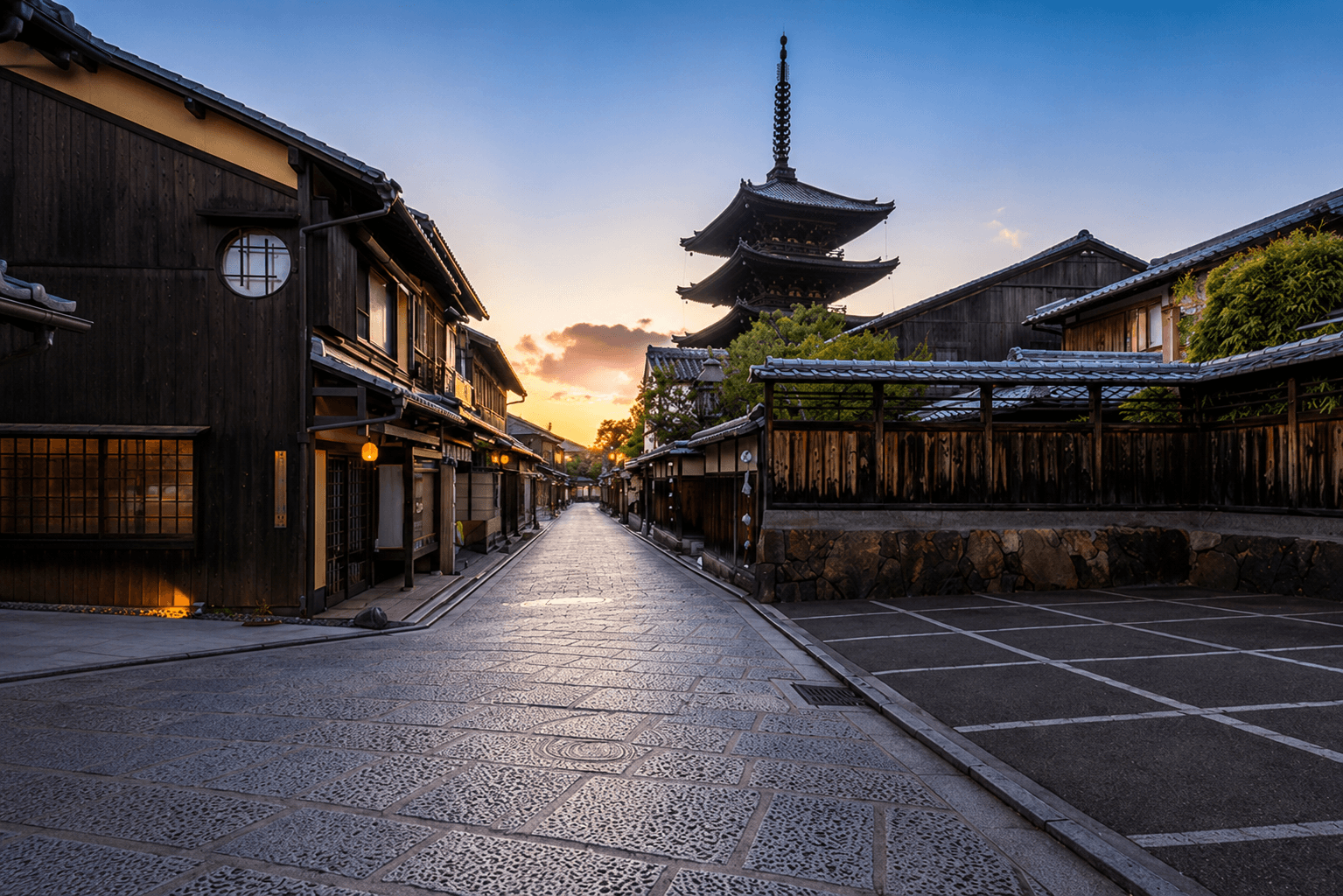
Pontochō is one of Kyoto's oldest quarters — a single lantern-lit alley, barely wide enough for two people to pass, running between the Kamo River and Kiyamachi in the centre of the city. Behind its narrow wooden facades sit ochaya, the traditional tea houses, most of which admit guests by introduction only. The one we work with carries no sign beyond a small ceramic motif set into the door lintel; access is arranged directly, and quietly, for guests we know.
By day Pontochō is almost secretive — shuttered facades, a scatter of ceramic name-plates, the smell of stock and charcoal from kitchens preparing for the evening. After dark it becomes one of Kyoto's last true hanamachi, the 'flower towns' where geiko and maiko — the city's word for its geisha and their apprentices — still train, entertain and move between engagements. You may see one crossing the alley at dusk, moving quickly and without display; the correct response is to give way and not to photograph, a courtesy the district increasingly has to ask for outright. The tea house we work with sits within this world rather than beside it, which is part of why access is handled as carefully as it is.
Where the tea comes from
Tea reached Japan with Buddhist monks returning from China, and it was in the Zen monasteries that powdered green tea first became a discipline rather than a drink. By the sixteenth century the tea master Sen no Rikyū had stripped the practice of its ostentation and fixed the aesthetic that still governs it — small rooms, plain utensils, an attention to the act itself over the objects involved. Chanoyu, as it came to be called, is less a recipe than a philosophy made procedural: every movement is prescribed, and the prescription is the point. What looks like ceremony is closer to a form of concentrated attention, practised until it looks like ease.
One time, one meeting
The Japanese tea ceremony — chanoyu, 'the way of tea' — is governed by a single idea the host will rarely state aloud: ichi-go ichi-e, 'one time, one meeting.' The phrase, tied to Sen no Rikyū and later drawn out by Ii Naosuke, holds that this gathering, in this light, at this hour, will never happen again in quite the same way — and should be treated accordingly. Everything about the two hours follows from it.
“Ichi-go ichi-e — one time, one meeting.”
— A guiding principle of the Japanese tea ceremony
What the two hours involve
Guests reach the room along the roji — a short garden path, damp-stoned and deliberately plain, meant to be walked slowly enough that the street is left behind by the time you kneel at the low sliding entrance. The doorway is cut deliberately small: historically even a sword had to be left outside, so that everyone entered on the same humble terms.
The entrance you kneel to pass through is the nijiriguchi, the 'crawling-in' door, cut low so that no one enters standing; in Rikyū's design even the highest-ranking guest had to bow to come in. Inside, the room is spare to a degree that can surprise a first-time guest. There is no furniture, no decoration beyond a single alcove — the tokonoma — which holds a hanging scroll and, often, one seasonal flower arranged so as to look barely arranged at all. The scroll is chosen for the occasion and may carry a single line of calligraphy; asking the host about it, at the right moment, is part of the exchange the room is built to hold.
Inside, guests are seated on tatami in a small tea room — often a yojōhan, the four-and-a-half-mat space long considered ideal for intimacy — and the ceremony proceeds largely in silence. Charcoal is laid, water is brought to heat, and matcha is whisked bowl by bowl through a sequence of unhurried, exact movements. There is no running commentary. The quiet is not an absence of information; it is the form itself.
Each object has a name and a place. The tea is measured with a chashaku, a slender bamboo scoop, from a lacquered caddy called a natsume; it is whisked in the chawan, the bowl, with a chasen, a whisk cut from a single piece of bamboo into dozens of fine tines. Water is drawn from an iron kettle, the kama, set over the hearth. None of it is incidental. A host may use a bowl made centuries ago or one thrown last year by a potter they know; either way it will be turned, examined and spoken of, because the utensils are not tools that vanish behind the tea — they are part of what you have come to meet.
Before the tea itself comes a small seasonal sweet — wagashi, shaped and tinted to the month — eaten to offset the matcha's bitterness. Then the host purifies each utensil in front of you, folding and refolding a silk cloth through a fixed sequence of movements. Watching it closely is part of the ceremony, not a delay before the real thing begins.
The aesthetic at work is wabi-sabi — a preference for the plain, the weathered and the imperfect over the polished. The bowl you are handed may carry a visible repair; the single stem in the alcove will have been chosen that morning. Between bowls the host may offer one sentence, about the season or the clay you are holding, and then let it stand. It is offered once, the way the tea is.
The host — the teishu — has usually spent far longer preparing than the ceremony itself will last: choosing the scroll and the flower, laying the charcoal so it burns to temperature at exactly the right moment, cleaning the room to a standard the guest is not really meant to notice. Much of the discipline is invisible by intention. What reaches you is only the surface of a great deal of unseen work, which is itself part of the meaning: the ease is earned, and the calm in the room is the residue of years of practice rather than a mood switched on for the evening.
For all its stillness, the room is full of small sounds, and part of learning to sit in it is learning to hear them. The iron kettle moves through its own register as the water comes up to heat — the tea masters have a word, matsukaze, 'wind in the pines', for the particular sighing note it reaches just before the boil. There is the tap of the bamboo scoop against the rim of the bowl, the brief storm of the whisk, the near-silent slide of a silk cloth being folded. A guest who spends the two hours waiting for something to happen tends to leave puzzled; a guest who listens tends to leave changed. The ceremony does not fill the silence. It teaches you to notice what is already in it.
Thick tea and thin
Depending on the seating, you may be served one or both of the two forms the tea takes. Usucha, 'thin tea', is the lighter, frothier bowl most visitors picture — whisked to a jade foam and drunk individually. Koicha, 'thick tea', is rarer and more formal: a denser, almost syrupy preparation made from the finest matcha and, traditionally, shared from a single bowl passed between guests, each turning it and wiping the rim before handing it on. Koicha is the quiet centre of a full ceremony, and being offered it is a mark of the occasion rather than a menu choice. The host will guide you through either without a word out of place.
How a guest behaves
Guests are not expected to arrive fluent in the form, and the host will lead you through it. A few courtesies carry the evening: receive the bowl with both hands and a slight bow; turn it a couple of times clockwise so as not to drink from its 'face', the front the host has deliberately turned towards you; finish in three or so sips, the last drawn deliberately; then turn the bowl back and set it down. When it is offered for you to admire, do so at floor level, both hands beneath it. Socks, ideally white, are worn on the tatami. Beyond that, the single most useful thing a guest can bring is a willingness to be slow.
A ceremony that changes with the year
No two seatings are the same, and much of the variation is seasonal by design. In the colder months the hearth is sunk into the floor, the ro, drawing guests close to the fire; in summer a portable brazier, the furo, is set further away to keep the heat at a distance. The sweet changes with the month — a plum blossom in February, a maple leaf in November — as does the scroll, the flower and the choice of bowl. This is where ichi-go ichi-e stops being an abstraction: even a guest who returns a year later, to the same room and the same host, will not sit through the same ceremony twice.
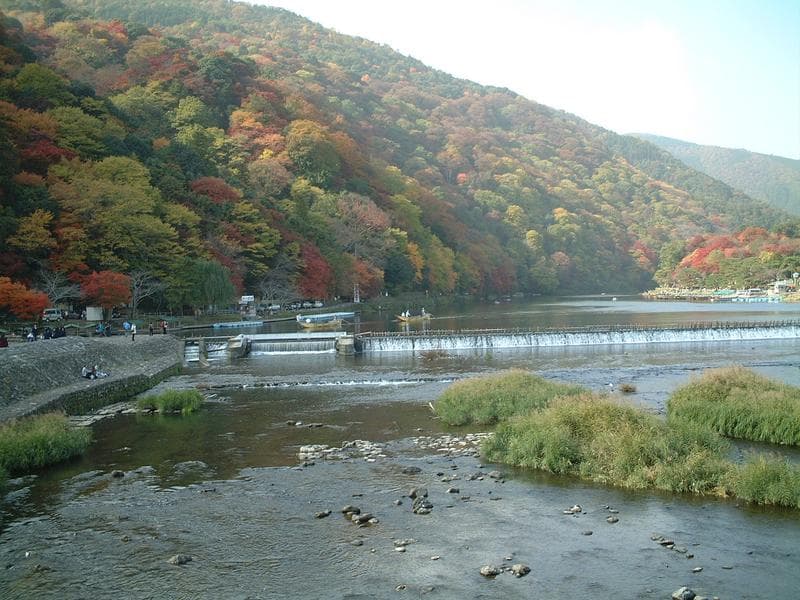
We usually set the ceremony as the still centre of a Kyoto day rather than one stop among many. A morning in the bamboo groves and temples of Arashiyama, in the city's west, pairs naturally with an afternoon seating; so does a slow walk through Gion or along the Philosopher's Path, depending on the season. What we avoid is stacking it against a full schedule. The two hours ask you to arrive unhurried, and an itinerary that has you rushing in from something and out to the next thing tends to undo them before they begin.
Kyoto rewards timing. Cherry blossom, at the very end of March into early April, and the maples of November are the two set-pieces, and both are extraordinary and extraordinarily busy; the tea house, being private and small, is one of the few things that stays calm through them. The deep of winter and the quieter weeks of early summer have their own case to make — fewer crowds, lower rates, and a city that feels more like itself. Whenever you come, the ceremony is best requested as the trip first takes shape.
Leaving is as measured as arriving. There is no lingering over a bill, no performance of thanks; you bow, you say little, and you step back out through the low door into the alley, where Pontochō has carried on without you. Guests often describe a strange recalibration in the first minutes afterwards — the phone back in the pocket, the noise of the street — as if the two hours had reset the pace of everything around them. That afterglow is, in a sense, the thing we are actually arranging.
The house sets its own ceiling of a very small number of private seatings each month — theirs to set, not ours. If you would like the ceremony written into a Kyoto itinerary, it needs to be requested early, ideally as the trip is first taking shape, so a date can be held before the calendar fills.