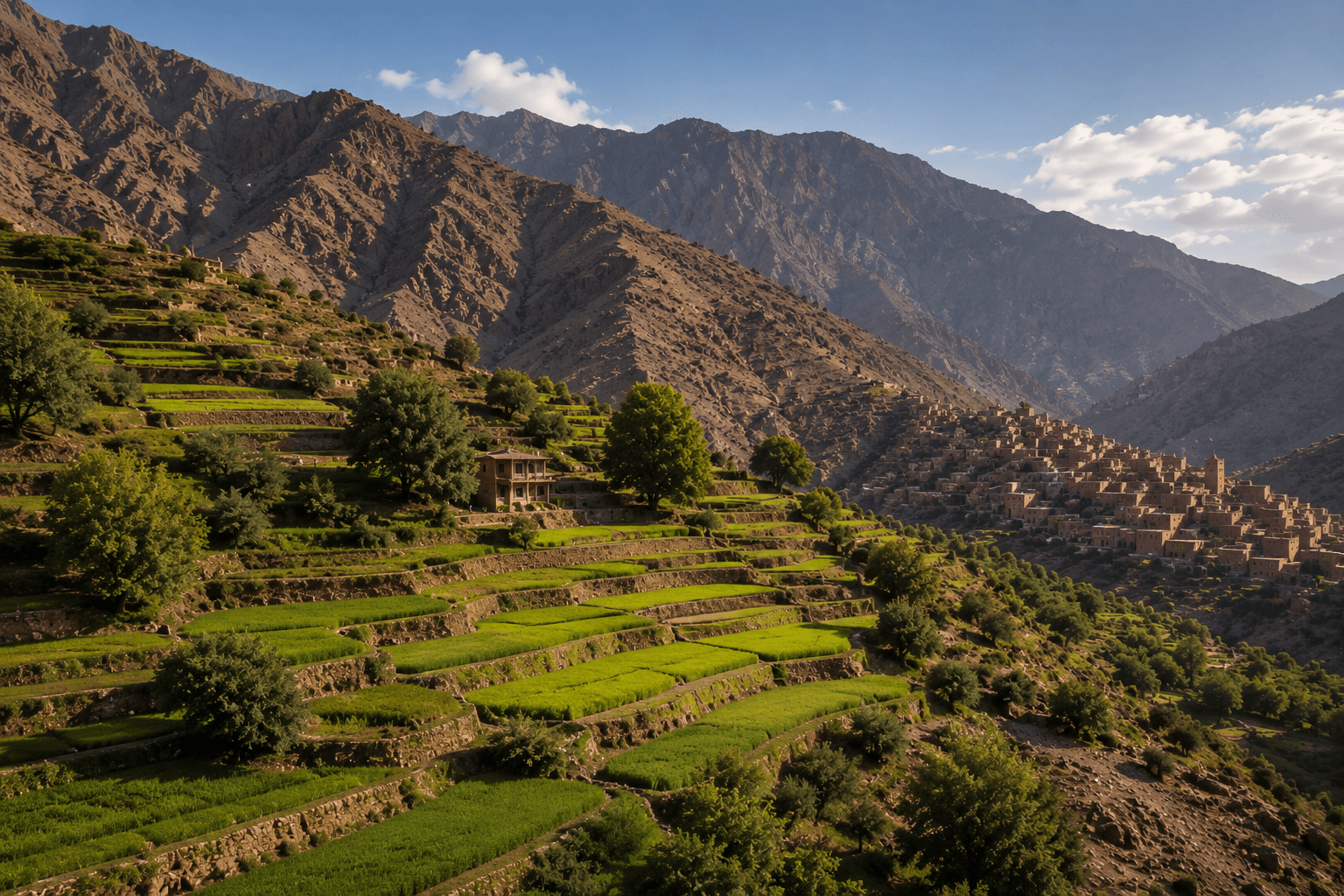
Imlil sits at roughly 1,740 metres in Morocco's High Atlas, a little over an hour south of Marrakech on a road that trades the city's souks for terraced fields and walnut orchards. For most travellers it is a trailhead — the last village before the ascent of Mount Toubkal, at 4,167 metres the highest peak in North Africa. We tend to route our guests the other way: not up and out towards the summit, but into the valley itself, where the oldest buildings solved problems of heat, privacy and stone long before anyone arrived to photograph them.
The drive out of Marrakech is itself part of the recalibration. The city's ochre ramparts give way within half an hour to the plain of the Haouz, and then the road begins to climb through Asni, past roadside stalls of pressed olive oil and the first switchbacks of the Toubkal massif. By the time the tarmac narrows to a single lane above Imlil, the temperature has dropped several degrees and the air carries walnut and woodsmoke rather than diesel and spice. Guests often remark that the journey feels longer than its ninety-odd minutes; distance here is measured in altitude and quiet as much as in kilometres.
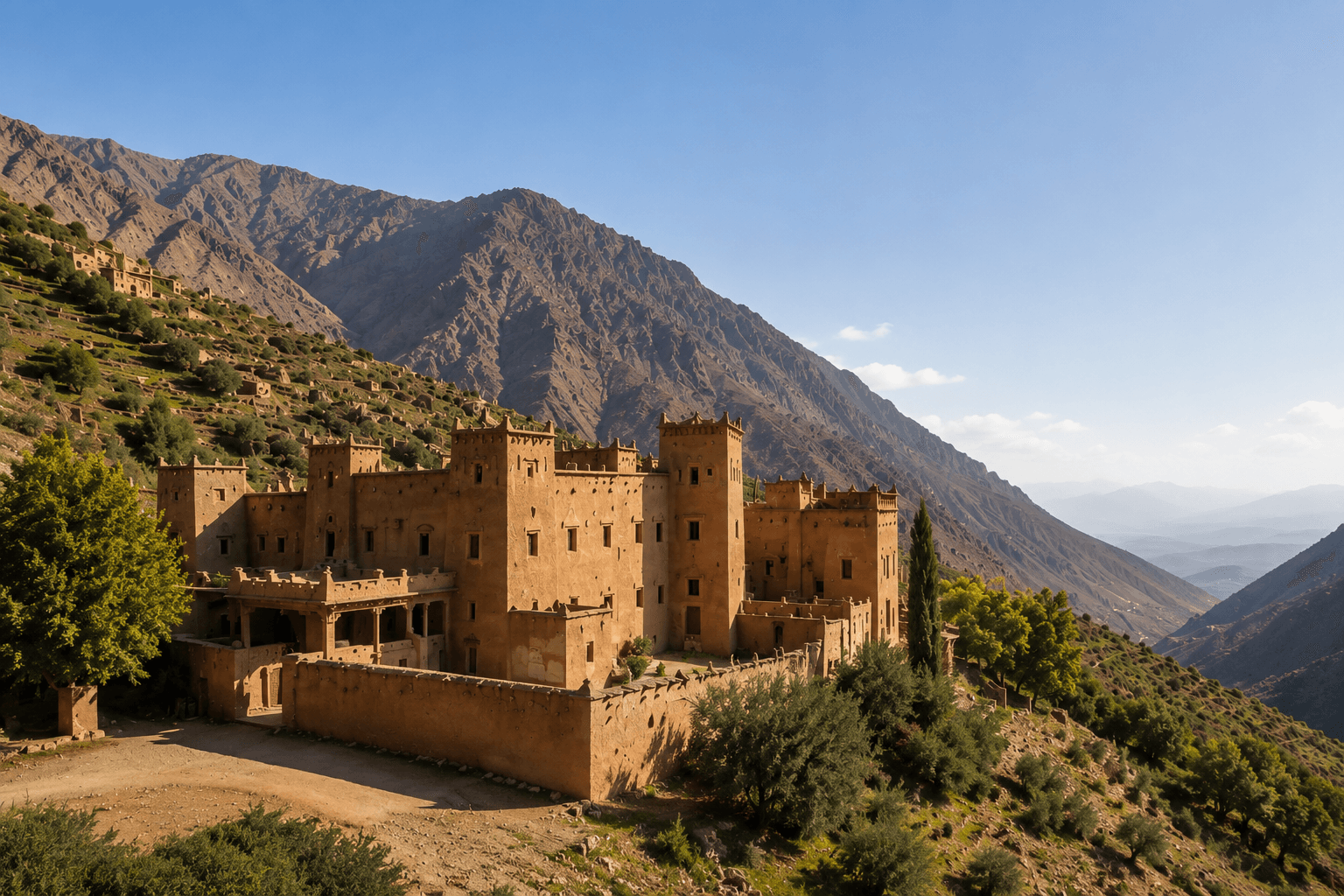
The kasbahs of the High Atlas are built of pisé — rammed earth and lime, dug from the same slope they stand on. The walls are thick enough to hold the night's cool through the afternoon and the afternoon's warmth into the night. None of it is decorative; it is a plain answer to a climate that swings hard between the two.
Reading the walls
Pisé is not a forgiving material. Built up in courses between wooden shutters, each layer tamped by hand and left to cure before the next is raised, a wall of any height is the work of a season and a crew. Its virtue is thermal mass: half a metre of packed earth absorbs the day's heat so slowly that the interior never quite catches up with the afternoon, then releases it back through the cold of a mountain night. Nothing is sealed or insulated in the modern sense. The building simply lags behind the weather, and that lag is the comfort.
Left untended, the same earth returns to the slope within a few winters, which is why you will see half-dissolved walls standing beside lived-in houses in every hamlet. A kasbah is less a permanent object than an argument the village keeps having with the rain — re-rendered each spring, patched where the frost has bitten, and abandoned without ceremony when a family moves on. It gives the valley its particular texture: nothing quite new, nothing quite ruined.
A house that turns inward
The plan of a traditional kasbah turns away from the view. Rooms gather around an interior courtyard rather than facing the valley — an arrangement built for shade, air and privacy rather than a panorama. It can feel counterintuitive to a first-time guest, since the best light in the house often falls on a tiled inner wall rather than a window. By the second morning, most people understand the logic of it. The quiet is the point.
Where there is ornament, it is geometric and hand-set: zellige, the mosaic of hand-cut glazed tiles fitted edge to edge with no printed pattern to follow. A single panel can take a craftsman weeks. Carved cedar ceilings, joined without nails, do the same work overhead. Nothing about the method is fast, and none of it is meant to be.
The craftsmen who still work this way are fewer each year, and most learned the trade as boys in Marrakech's tile yards rather than in the mountains. When a ceiling needs restoring, the family who owns the house will often bring a maâlem — a master craftsman — up from the city for weeks at a time, housing and feeding him while he works. It is expensive and slow, and it is the only way the knowledge stays alive. We tend to think of the houses we place guests in as small acts of preservation as much as places to sleep.
“We don't send guests to the High Atlas to conquer a mountain. We send them to sit inside a building that has already made its peace with it.”
— Sunday Pure Holidays
The people of the valley
The High Atlas is Amazigh country — the Indigenous people of North Africa, still widely called Berber, though many now prefer their own name for themselves, Imazighen, 'free people.' The language you will hear in the lanes of Imlil is Tashelhit, one of the Amazigh tongues, and Arabic and French come second and third to it. A guest is never expected to arrive with any of the three; a greeting learned on the first morning goes a long way, and is usually met with more amusement than correction.
Hospitality here is close to a civic obligation. Arrive at a house, even unannounced, and tea will appear before questions do; to refuse it outright is the one genuine discourtesy. Our guides are drawn from the valley itself rather than dispatched from the city, which changes the texture of a stay entirely — doors open that would stay shut for a stranger, and the walk to a neighbouring hamlet becomes a series of unhurried introductions rather than a route march past other people's lives.
Life in the valley still turns partly on the weekly souk, the market that rotates between villages by the day of the week — Asni on a Saturday is the closest of any size. It is where the terraces trade what they grow, where a household buys the month's sugar and tea, and where a guide will disappear for twenty minutes and return with the evening's vegetables and a piece of local gossip. We rarely programme it as a set-piece; it works far better stumbled into, on a morning when the market happens to be the one nearby, than staged for the sake of a photograph. The point of it is that it is not for you, and that is exactly why it is worth seeing.
At the table
Food in the mountains is plain, seasonal and slow, and most of it emerges from a single vessel. The tagine — both the conical earthenware pot and the dish cooked in it — sits over low coals for hours, steam circulating back down the cone so that a little water and a lot of time do the work of a full kitchen. Lamb with prunes and almonds, chicken with preserved lemon and olives, or simply seven vegetables for a house without meat that day: the contents change with the season and the market, the method never does.
Bread is baked communally in many hamlets, carried to a shared wood oven as raw rounds each morning and collected, marked and warm, an hour later. And there is mint tea, poured from a height to raise a head of foam and offered at every threshold of the day — the 'Berber whisky' of the guides' own joke. It is sweet by design; declining the sugar is possible but tends to puzzle the host. None of this is staged for visitors. It is simply what the day is built around, and guests slot into it rather than the other way about.
What a stay looks like
A day here is deliberately unstructured. Mornings might be a slow walk to a neighbouring hamlet such as Aït Souka, about forty minutes on foot, where a communal oven still bakes the village's bread and a weaver works a loom older than the road below. Afternoons tend to empty out on a terrace; evenings move to the rooftop, where the call to prayer carries across the valley as the stone gives back the day's heat.
The shape of a morning
A representative morning: tea on the terrace as the sun clears the eastern ridge, then a walk of an hour or two along the contour paths that link the hamlets — Aroumd, Aït Souka, Tamatert — each a cluster of earth houses around a mosque and a threshing floor. These are working villages, not open-air museums; you pass men mending irrigation channels, women carrying fodder, children walking to the school in the valley. The guide sets a pace closer to a stroll than a hike, stopping wherever there is someone to greet or a view worth standing in. You are back before the heat, with the whole afternoon still ahead and nothing planted in it.
The terraces themselves repay attention. Every field is fed by seguias — narrow earthen irrigation channels that carry snowmelt down from the heights and divide it between households on a schedule as old as the village, timed by the sun and settled by consensus rather than any authority. Walk the valley for a morning and you begin to read it: the channels, the walnut trees that mark a boundary, the flat threshing circles worn into the rock. It is a landscape entirely made by hand, and still maintained that way.
By day: terraced orchards, mule paths, and the long light the mountains hold late into the afternoon.
By night: a wood stove, thick earthen walls, and no reason to be anywhere before morning.
Evenings settle early. Once the light goes, there is little to do and less reason to do it — a fire, a slow dinner whenever it is ready, the sky filling with more stars than most guests have seen at once. The Wi-Fi, where it reaches, is best left alone; the valley does its most persuasive work in exactly the hours when there is nothing to look at but what is in front of you. People who arrive braced for boredom tend to leave asking how soon they can come back.
When to come
Spring, from March into May, is the valley at its most generous: the orchards in blossom, the terraces green, the high peaks still holding snow for contrast rather than obstruction. Autumn, from late September through November, trades the blossom for the walnut and apple harvest and some of the clearest air of the year. Summer is hot on the plain below but tempered by altitude here, and the nights stay cool enough for the wood stove. Winter brings real snow to the passes and a hush over everything; the houses are built for it, and a stay then has a particular, banked-fire stillness — though the higher trails close and the road can demand patience.
Practically, a stay asks very little of you. There is no permit, no specialist kit and no altitude of any consequence at village level — Imlil sits lower than many alpine resorts. Walking shoes, a warm layer for the evenings whatever the season, and a tolerance for intermittent hot water and slower connections are the whole of it. Phone signal reaches most of the valley but thins as you climb; we treat that as a feature and plan around it rather than against it.
If you are planning a Morocco itinerary with us, the High Atlas usually sits as a two- or three-night stay before or after Marrakech — long enough to slow the pace, short enough to need no trekking permit or specialist kit. We arrange the transfer, the house and a guide who actually lives in the valley; the emptiness of the days is left to you.
What guests take home is rarely a photograph of a summit they never climbed. More often it is the memory of a particular quality of quiet — a courtyard at midday, the stone giving back its heat after dark, a valley that has been solving the same handful of problems, in the same handful of ways, for a very long time. That is what the architecture is for, and it is what we route people into it to feel.