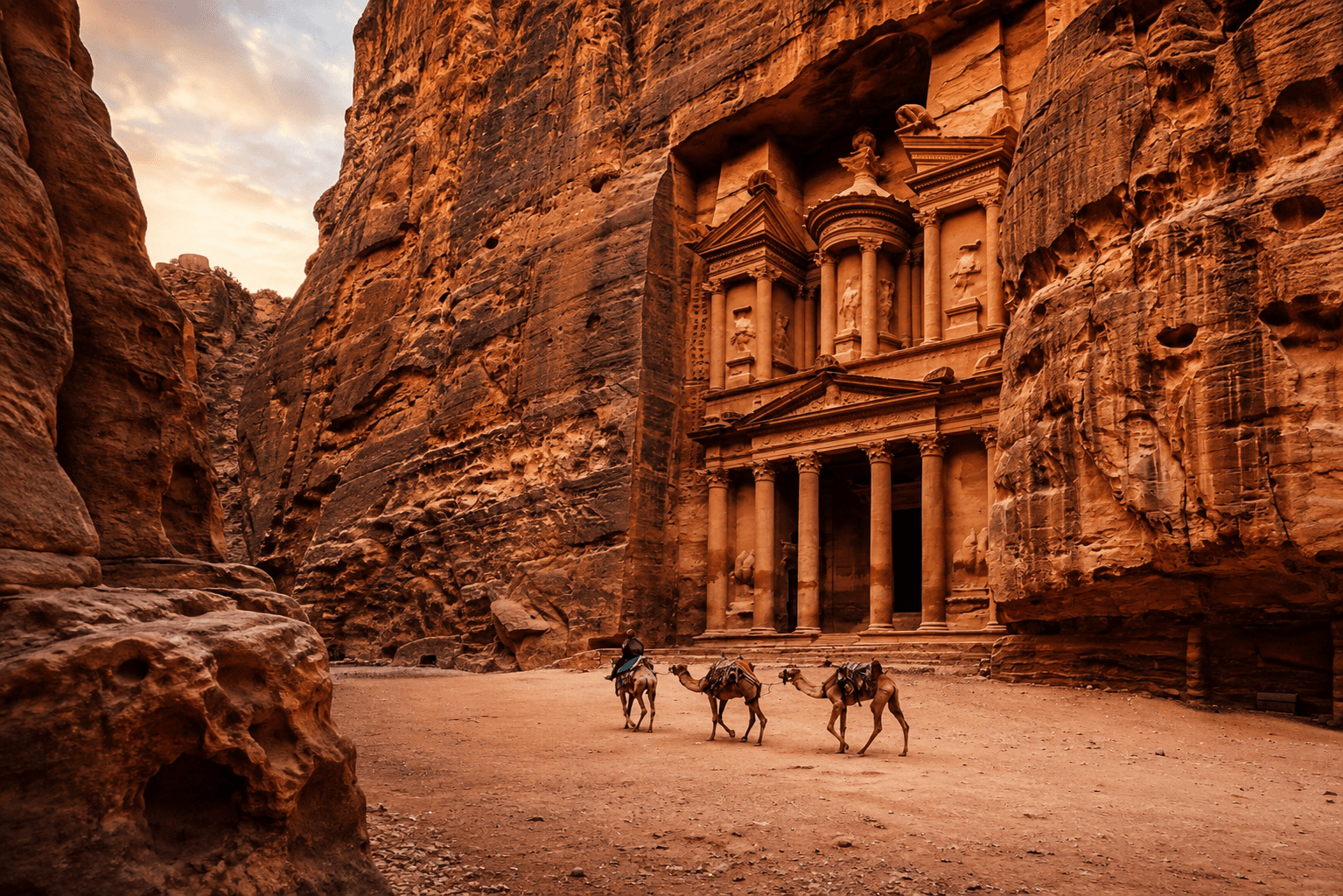
Almost everybody arrives at Petra the same way: through the visitor centre, down the Siq, and out into the light in front of the Treasury with several hundred other people doing exactly the same thing. It is a genuinely great piece of theatre and we have nothing against it. But it means the city is met at its most photographed point and worked through backwards, and by the time most visitors reach the far end they are too tired to look. This route reverses it. We come in over the plateau from Little Petra, arrive at the Monastery from behind, and walk down through the city towards the Treasury — which you meet at the end of the day, from the inside, as the crowds are leaving.
Petra was the capital of the Nabataeans, an Arab people who grew wealthy taxing and protecting the caravan trade in frankincense and myrrh moving north out of Arabia. The carved facades that everyone recognises — cut into the rock rather than built out of it — mostly date to the last century BC and the first century AD, and mostly mark tombs and ceremonial halls rather than houses. What is easier to miss, and more impressive, is the water engineering: dams, rock-cut channels, ceramic pipe and cisterns that took an ephemeral desert stream and made a city of perhaps twenty thousand people possible in a place with no business supporting one.
Most guests fly into Amman and drive south — roughly three hours on the Desert Highway, or nearer five on the King's Highway through Madaba, Mount Nebo and the Dana escarpment, which is the better drive if the day allows it. Coming the other way, Aqaba's airport is about two hours from Petra and forty minutes from Wadi Rum, which makes it the easier arrival if the trip is being built around the desert rather than the city. We arrange the transfers either way, and we always put a night in Wadi Musa before the walk rather than after the flight.
The walk begins at Siq al-Barid, about nine kilometres north of the main gate and known to almost everyone as Little Petra. It is a genuine Nabataean site in miniature — a cold, narrow gorge with carved dining halls cut into both walls, where the caravans that could not be accommodated in the city itself were housed and fed. Above one of them is the Painted House, whose ceiling still carries Hellenistic fresco: vines, birds, small winged figures. It is one of very few surviving Nabataean paintings anywhere, it takes a short ladder to see properly, and most people who come to Jordan never hear about it.
The guides
The back route is not a stroll you can take on your own, and since the park tightened its rules the backcountry trails require a licensed guide — which is the right outcome, and not only for safety. The guides on this route are Bdoul Bedouin, whose families lived in Petra's tombs and caves until 1985, when the site's World Heritage listing moved them to Umm Sayhoun on the ridge above. That is recent enough that the man walking ahead of you may well have been born in one of the chambers you pass. Very little of this gets narrated unless you ask. When it does, it tends to arrive flatly, without grievance, which is somehow harder to sit with than if it did not.
The walk in: Little Petra to the Monastery
The trail climbs out of Little Petra onto open sandstone plateau and runs south for two to three hours, depending on the pace and how often you stop. It is not technical and there is no exposure to speak of, but it is uneven underfoot the whole way — slickrock, loose sand, a few worn Nabataean stairs cut straight into the rock — and there is no shade for long stretches. What it does have is emptiness. The main city can hold several thousand people on a spring morning; on this trail you may pass a Bedouin tent, a herd of goats and nobody else at all.
You reach Ad-Deir, the Monastery, from above and behind. It is the largest carved facade in Petra — around forty-seven metres across and nearly fifty high, big enough that the doorway alone is taller than a house — and the classic approach is a climb of some eight hundred rock-cut steps up from the valley floor, in full sun, at the end of a long day. Arriving on the plateau instead means meeting it level, unhurried, from a direction almost nobody uses. Guests tend to say very little for the first few minutes.
From there the day runs downhill, which is both literal and the point. You descend those eight hundred steps rather than climbing them, into the Basin and the colonnaded street, past the Great Temple and the Royal Tombs with the afternoon light moving round onto them. Then the Theatre, then the Street of Facades, and finally the Siq — entered from the wrong end, so the Treasury appears behind you rather than in front. By this hour the day-trip coaches have gone. The last stretch out through the gorge, in shadow, with the walls a hundred and eighty metres above and almost nobody in it, is the quietest Petra gets.
What the rock is doing
The sandstone here is Umm Ishrin and Disi, laid down in shallow seas and deserts several hundred million years ago and stained by iron and manganese into bands of rust, ochre, violet and near-white that run through the carved chambers like grain through timber. The Nabataeans knew exactly what they were working with and cut to expose it. Two thousand years of wind and flash flooding have since taken the crisp edges off almost every facade — the Treasury has kept its detail largely because the Siq shelters it — so what you are mostly looking at is a collaboration between the carvers and the weather, still ongoing, and not in the carvers' favour.
“Arriving at the famous view first is the surest way to spend the rest of the day comparing everything to it.”
— Sunday Pure Holidays
South to Wadi Rum
Wadi Rum is about a hundred kilometres south, an hour and a half of driving, and the transition is abrupt in a way that photographs never manage. Petra is vertical, enclosed and worked by hand; Rum is horizontal and almost entirely untouched — seven hundred square kilometres of protected desert where granite and sandstone massifs rise straight out of red sand with no foothills to speak of, so the scale never quite resolves. It is a UNESCO site for its rock art as much as its landscape: the petroglyphs at Khazali and Anfashieh record camels, ibex and human figures across some twelve thousand years of people passing through.
The afternoon is spent in a 4x4 with a Zalabia driver from Rum village, which is the standard way to move here and remains the best one. Khazali canyon on foot for the inscriptions, the Um Fruth rock bridge if there is appetite for scrambling, and a long slow run out to the dunes for the last of the light. The Seven Pillars of Wisdom, the wall above the village, is named after the Lawrence book rather than the other way round — a small correction the drivers enjoy making, and one worth knowing before you make the mistake yourself.
Where you sleep
The night is spent in a Bedouin camp — traditional black goat-hair tents rather than the transparent domes that have multiplied across the valley in recent years. The domes photograph well and sleep badly, and they put a layer of plastic between you and the one thing you came for. What we use instead is woven wool, rugs, proper mattresses, a shared fire and a bathroom block that works. It is comfortable rather than luxurious, and deliberately so.
Dinner is zarb, cooked the way the camps have always cooked it: lamb or chicken and vegetables layered into a metal frame, lowered into a pit in the sand over embers, sealed under a blanket and buried for three or four hours. The theatre is in the digging up rather than the cooking — the sand comes off, the frame comes out clouded in steam, and everyone stands round it. There is flatbread, rice, too many small dishes to finish, and sweet tea with sage kept coming from a pot at the edge of the fire until somebody finally says no.
Then the sky, which is the real reason for the night. There is no settlement close enough to put a glow on the horizon and no moisture in the air to soften anything, so the Milky Way comes up hard and detailed and the drivers will happily lie flat in the sand and name things for as long as anyone stays awake. Bring a layer more than you think: the desert loses its heat the moment the sun goes, and a night that was thirty degrees at dinner can be near freezing by four in the morning. The camps know this and there are more blankets than you will need.
By day: sandstone, cut stairs, two thousand years of weather winning slowly.
By night: goat hair, a fire, and a sky with nothing at all in the way of it.
When to go
March to May and September to November, without much argument. The spring weeks are the best of it — warm rather than hot, and after a wet winter there is real green and wildflower across ground that spends the rest of the year looking incapable of it. High summer is genuinely punishing on the plateau, where there is no shade and afternoon temperatures run past forty degrees, and we will talk guests out of a July walk. Winter is quieter and can be beautiful, but nights in Rum drop below freezing and a flash flood will close the Siq without notice.
What it asks of you
This is a walking route, not a trek: two to three hours in on the plateau, then several more on your feet working down through the city. No scrambling is required and no head for heights, but the ground is uneven throughout, the descent from the Monastery is long and hard on the knees, and there is no way to shorten the day once you have started — there is no vehicle access to the middle of it. Proper shoes rather than trainers, more water than seems reasonable, a hat, and the willingness to be out in the sun for most of a day. Guests who would rather not walk the plateau can be brought in through the main gate and met at the Monastery instead; the rest of the day is unchanged.
Set against the usual two-day Petra ticket, this trades a second pass through the same ground for one long, properly-guided day arriving from an angle most visitors never see, followed by a night that has nothing to do with archaeology at all. We handle the guide, the park permissions, the transfers, the camp and the driver, and we keep the group small enough that the plateau stays empty.
Guests who come to us for Jordan usually arrive with one image in mind, and it is always the same one: the Treasury framed by the last few metres of the Siq, the photograph everyone already owns. We are not trying to take it away from them. We would just rather they earned it at the end of the day, walking out, with the light going and the gorge empty — instead of collecting it in the first ten minutes and spending the rest of the day looking for something to match it.